

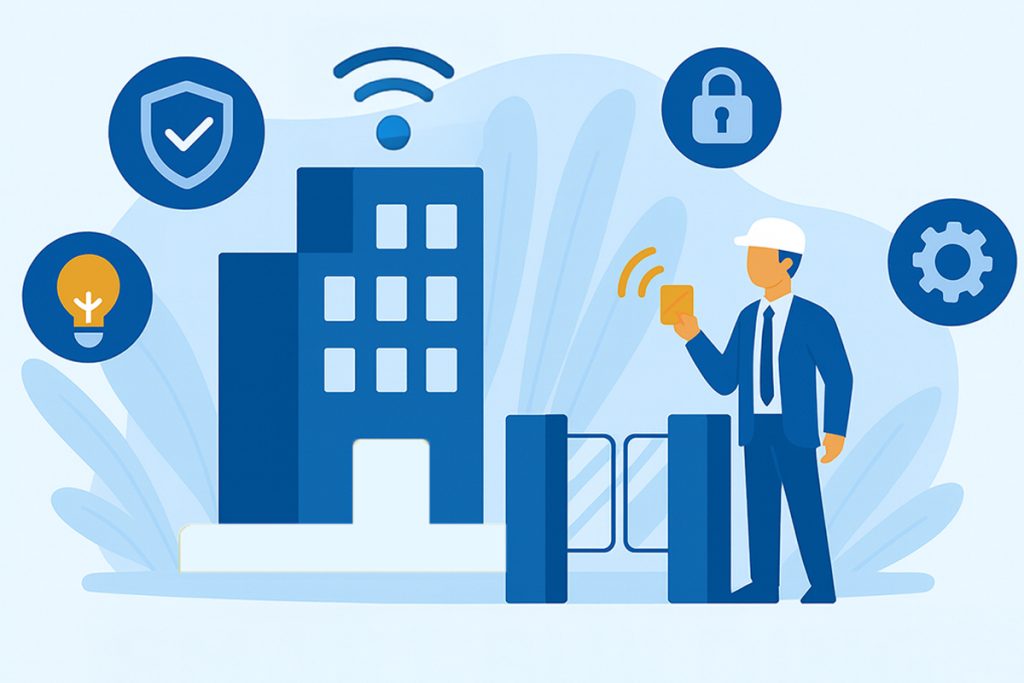
Smart Building and access control: security and convenience go hand in hand.
Smart buildings are on the rise. More and more organisations are investing in a smart building: a building that uses sensors, networks and smart software to respond to the presence, wishes and safety of the people who work or stay there.
These technologies make the building think with its users, so to speak. Think automatic lighting, customised climate control and recognition-based access. But what exactly is a smart building? And why does access control play an important role in it?
In this blog, we explain what smart buildings are, the benefits they offer, and how modern access technology plays a key role in this.
What is a smart building?
The meaning of smart building is a building that functions sustainably and efficiently thanks to sensors, data links and smart software. Think lighting that dims when there is sufficient daylight, heating that automatically adjusts to occupancy and ventilation that responds to air quality.
In such a building, users are central. Systems are interconnected and tune their operation according to presence, behaviour and preferences. This creates a comfortable, safe and energy-efficient working environment. The building thus actively contributes to the well-being of its users, without them having to think about it consciously.
Smart buildings are no longer a trend for the distant future. The technology has matured and become affordable, allowing medium-sized and smaller organisations to make the switch as well. The benefits are compelling: lower energy costs, better space utilisation, increased comfort and an improved user experience. Moreover, these buildings contribute to sustainability and organisations' broader ESG goals.
View range
Get in touch
Get in touch
“Access control is no longer just a security measure; it is the starting point of everything that makes a building smart.”
Smart building solutions and benefits
The power of a smart building lies in technology working together. Sensors, cameras, building management systems (BMS) and software platforms continuously exchange data. Based on this, processes are automated or optimised. Some concrete applications:
- Power management:
Lighting, heating and cooling are controlled automatically based on usage and weather conditions. This reduces consumption and prevents waste. - Space use and planning:
Measuring occupancy rates enables more efficient use of meeting rooms or dynamic allocation of workstations. - Predictive maintenance:
Installations tell themselves when maintenance is needed, preventing breakdowns. - Smart hospitality:
Guests can be pre-registered digitally, after which they are automatically given access to the appropriate rooms upon arrival. - Smart building security:
Camera surveillance, access control and alarms are integrated into one clear platform.
In all these applications, data is the foundation. By gaining insight into building behaviour, usage and performance, facilities teams can manage proactively and make strategic decisions. Smart buildings provide grip, scalability and continuous insight into how a building is performing.
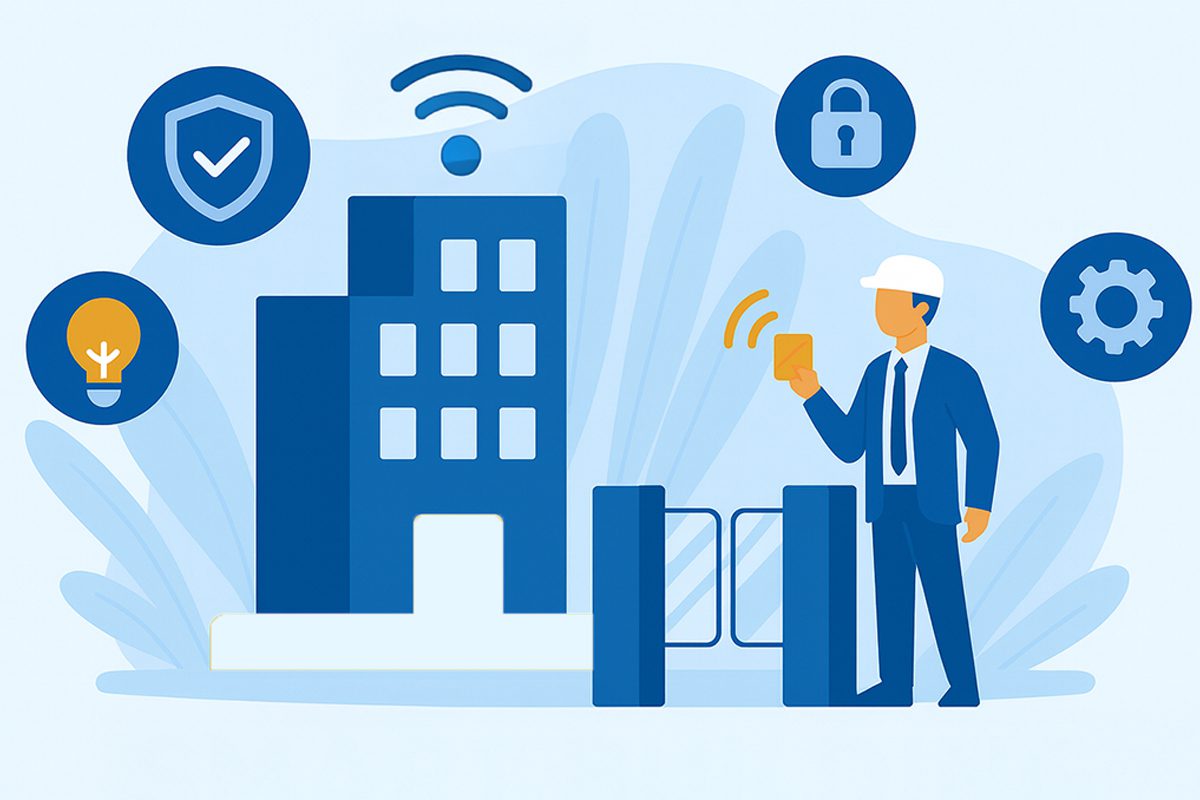
The role of access control in smart buildings
Smart building access control is not a standalone system, but an essential part of the whole infrastructure. Where before it was just about keeping unauthorised people out, now it is about flexibility, insight and ease of use.
What makes access control in a smart building different?
It is personal and flexible: employees, visitors and suppliers only get access to rooms relevant to their function or appointment. These rights can be managed centrally and by time period.
- The system is self-learning and connected: as soon as someone enters the building, it automatically activates other systems such as lighting, climate and lift controls.
- There is real-time insight: dashboards show who is in, where someone is and how busy certain locations are.
- It is secure and reliable: by combining technologies (badges, biometrics, smartphone apps), identity verification is more accurate than ever.
Moreover, access control provides a wealth of data. Think peak times, popular routes or underutilised areas. These insights are valuable for improving workplace strategies, planning cleaning rounds or sizing security.
Walk-through locks: smart access for busy locations
An important physical component in modern access control are speed gates. These are advanced entrance gates that combine speed with security. In smart buildings, they are deployed at main entrances, staff entrances or other important passages.
Walk-through locks work on the basis of smart sensors and software that assess in real time whether someone is allowed access. As soon as an authorised person approaches, the lock opens immediately and smoothly. If an unauthorised tailgating attempt is detected, the lock closes automatically.
The great advantage is that each person is checked individually without impeding flow. Where regular gates might slow things down, walk-through locks actually ensure professional, welcoming and safe access.
At Geran Access Products, we work with the dFlow. This innovative walk-through lock operates in the open position by default. Only in suspicious situations does the system close automatically. This creates an extremely user-friendly experience for employees and visitors, without compromising on security.
Pass-through locks such as the dFlow also offer a sleek and modern design, which fits well with the look and feel of smart buildings. They are compatible with almost all access control systems and can be linked to software for attendance, time recording and emergency procedures.
Benefits of smart throughput locks within smart building context
- Fast flow: no unnecessary queues, even at peak times.
- Maximum control: each individual passage is validated.
- Data insight: passages are recorded and analysed.
- Customised security: tailgating and unauthorised access are automatically blocked.
- Integration: seamlessly link to BMS, HR systems and cloud platforms.
This combination of advantages makes walk-through locks an essential part of a secure and smart access infrastructure.
Smart building and access control: ready for the future
A smart building is more than a smart climate or fancy app. The real power lies in the mutual cooperation of all systems, with access technology as the connecting element. Smart building security forms the gateway to all other functions. After all, a building only knows what to do once it knows who is inside.
Pass-through locks are a powerful solution here: safe, efficient, intuitive and fully integrated into today's and tomorrow's building systems. With smart technology such as the dFlow, Geran Access Products responds to the growing need for access solutions that fit modern organisations.
Wondering how we can make your building smarter and safer?
Please Contact on for advice. We are happy to think with you.