

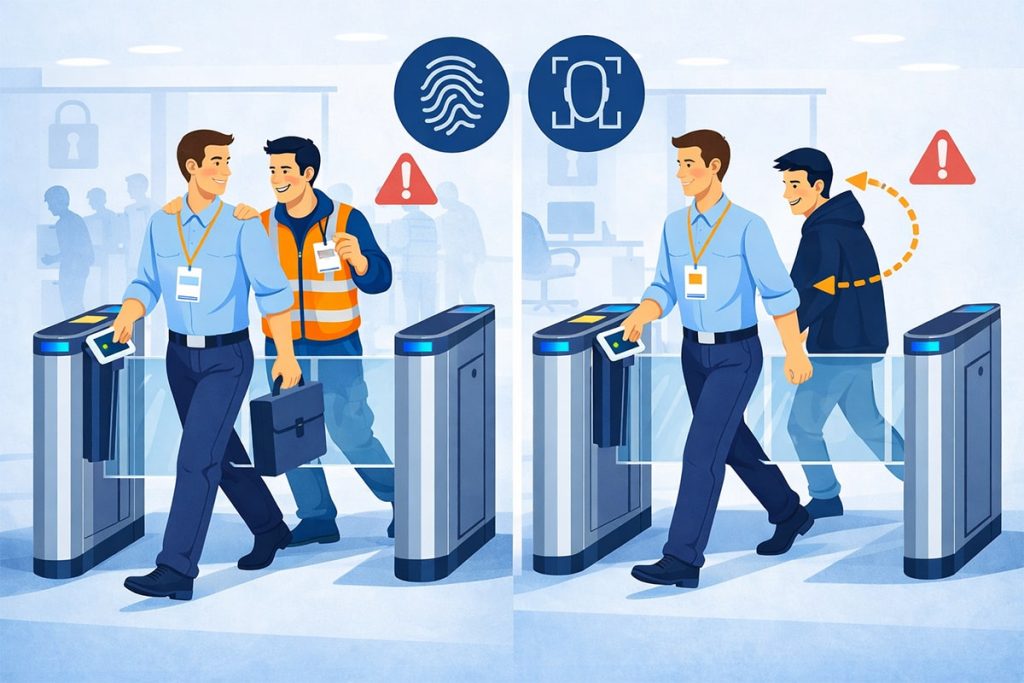
Tailgating and piggybacking: the silent threats to your corporate security.
Find out how to effectively prevent unauthorised access. You want to keep out intruders and visitors with wrong intentions, so you invest in security measures for your business. But then you have to deal with tailgating and piggybacking; two concepts in the security world that pose the biggest challenge in implementing physical access control. The concepts of tailgating and piggybacking are about entering an area without proper authorisation. In many cases, this can be harmless, for example when people know each other and one lets the other in. Yet criminals and intruders like to take advantage of this innocent-looking situation and use tailgating and piggybacking to try to slip through security with them. And where access barriers are unintentionally passed, the level of security decreases. High time to elaborate on these concepts and identify solutions.What is tailgating?
Tailgating can be compared to tailgating, but at an access point. An authorised person gains access, after which a second person follows directly behind and passes the same physical barrier unnoticed. Sometimes this happens because someone holds open a door out of kindness, without realising that the person behind them does not have access. The distinctive feature in tailgating is that the authorised person is unaware of the intruder.What is piggybacking?
In piggybacking, the authorised person is indeed aware of a second person ‘riding along’ through the access control. This does not automatically mean that the first person has evil intentions. Intruders can, for example, pretend to have permission, or pressure someone to “piggyback along”. In practice, a fake staff badge, work clothes and a confident attitude may be enough to avoid being noticed. An intruder may also blend into a large group of authorised people, making control more difficult.

Is biometrics the solution to tailgating and piggybacking?
Biometric identification is increasingly used within access control. Think of systems that work with:
- Fingerprints
- Face recognition
- Iris scans
- Voice recognition
The big advantage of biometrics is that it works on the basis of unique, personal characteristics. This prevents someone from gaining access with a borrowed or stolen access card. The identification rate is high, which makes the system more reliable than traditional means of access.
But is that enough to stop tailgating and piggybacking? The short answer: no, not always. Biometrics does prevent unauthorised people from requesting access themselves, but it does not stop someone from walking with an authorised person. To effectively prevent that, a combination of:
- Proper identification (such as biometrics or badges)
- Physical access control that lets only authorised persons through
Consider physical solutions such as:
- Speed gates or speedgates with sensor systems
- Lock arrangements where only one person is allowed through at a time
- Access detection with anti-tailgating technology (e.g. infrared sensors)
How Geran Access Products supports this At Geran Access Products, the focus is on physical access products and solutions. We supply, among others:
- Speed gates (such as dFlow or dGate)
- Turnstiles and wide passages
- Detection and flow control solutions
Our solutions can be easily linked to existing access control software and biometric systems. We work with specialised installers who combine software and hardware into one secure total solution. This way, you establish a strong, physical barrier against unauthorised access via tailgating or piggybacking.
Access control with Geran Access Products BV
It is important to apply the right technologies and measures to prevent unauthorised access, also known as intrusion prevention. We offer several solutions that provide a physical barrier against unwanted intrusion. With Tripod turnstiles control your access and steer visitors in the right direction in a controlled way. Man-sized revolving doors offer a higher level of security by completely sealing off passage. It greatly reduces tailgating and piggybacking, as only one person per rotation is allowed through. In the video below, see how tailgating is prevented with one of our glass turnstiles. https://www.youtube.com/watch?v=3InFMOmzhg8https://www.youtube.com/watch?v=3InFMOmzhg8Tailgating and piggybacking at walk-through locks
Preventing tailgating and piggybacking without making your entrance feel immediately “closed” is often the challenge. Many physical access control systems set a clear barrier, but that can clash with the image you want to portray as an organisation. The dFlow Speed gate has been developed to combine safety and appearance. People can pass smoothly, while the system actively monitors what is happening in the lock. Basically, the doors open and close when a non-automated user is in the lock. They open again as soon as that user is out of the detection area. Access can be granted to several users at once, but as soon as one of the users is not authorised, the doors close until that particular person moves out of the lock. Watch the demonstration in the video below. https://youtu.be/gqTvuCmUWMshttps://youtu.be/gqTvuCmUWMsChecklist: how to reduce the risk of tailgating and piggybacking
- Make clear rules: no one enters without valid authorisation
- Do not let access systems “tag along” on courtesy, but on verification
- Choose physical barriers that enforce one person per passage
- Combine identification (pass or biometrics) with access products that stop unwanted passage.
- Evaluate walking routes and busy times; this is where most incidents often occur.